Why Sam Altman Dropped Phones for a 5GW Power Grid
An engineering read of Sam Altman's interview: OpenAI's hardware with Jony Ive, the power wall, and the math limits of recursive self-improvement (RSI).
In the middle of the vast desert outside Abilene, Texas, a 500-megawatt (MW) mega data center is under construction. On the site manager’s desk there is no blueprint for NVIDIA’s latest AI server rack. Instead there is a binder with the delivery schedule for a 345kV-class large transformer (a GSU transformer) bound for a high-voltage substation. Order one of these specialty transformers on the global power equipment market today, and it takes an average of four and a half years for it to reach the factory floor.
When OpenAI CEO Sam Altman sat down for a long, closed-door interview recently, his eyes were fixed on exactly this point. It wasn’t a race over model parameter counts or a boast about benchmark scores. It was the physical limits of the power grid, the bottlenecks in semiconductor packaging lines, and the mathematical and engineering boundaries facing the recursive self-improvement (RSI) loop, in which AI improves its own code.
“For the past few months I haven’t personally reviewed a single line of code in our product deployment pipeline. All development work has fully moved to higher-level agent orchestration.”
Altman’s calm declaration doesn’t only mean that the nature of programming labor has changed at its root. It also signals that the volume of compute the entire software industry will have to carry is expanding explosively. Here we dissect, from a systems engineering perspective, the idea of an in-house physical device (form factor) that goes beyond the rectangular glass slab of the smartphone, the Jevons paradox that swallows power grids whole, and the nature of the deterministic control needed to keep probabilistic intelligence in check.
Ambient hardware design philosophy
Many media outlets approach the secret hardware project between Sam Altman and former Apple chief designer Jony Ive with the stale framing of “a new phone to replace the smartphone.” But the physical device Altman stressed throughout the interview is not a substitute for the smartphone. It is an entirely different category of computing.
The smartphone is a device that aggressively extracts human attention. It works only when you pull it out of your pocket, turn on the screen, tap an app icon, scroll, and monopolize your visual cortex. The core of the next-generation hardware OpenAI has in mind, by contrast, is an ambient computing environment that doesn’t get in the way of human senses.
It melts into a space, whether on a user’s desk, in the corner of a meeting room, or as a light wearable, and perceives real-world context in real time through visual sensors and a microphone array. The moment a user says, “Compare that idea with the numbers we discussed in yesterday’s meeting,” the device cross-references past context and the current conversation in vector space with no extra interaction, and executes only the key action needed.
Building such an always-aware device means solving three hardware engineering challenges that look nothing like those of existing mobile devices.
-
A sub-1-watt, low-power edge NPU suited to always-on sensing
To watch ambient sound and video frames around the clock while the battery lasts for days, the main high-performance application processor (AP) has to stay asleep, and an ultra-low-power NPU alone has to do the semantic filtering. -
Zero-latency multimodal compression on the device
Streaming every voice stream and high-resolution 4K video frame to a central cloud 24 hours a day is physically impossible in terms of network bandwidth, privacy, and server cost. Layered on-device preprocessing is essential: remove noise inside the device, do a first-pass compression into dense embedding vectors, and send only that to the center. -
Deterministic voice feedback in a screenless environment
No display means no error messages and no confirmation pop-ups. Because a probabilistic answer from the model translates directly into an action in the physical world, you need a safety interlock circuit that blocks hallucinated output at the hardware level.
Broadcom custom NPU architecture
Behind OpenAI’s turn from software company to in-house silicon design lies a distorted cost structure that depends on a single NVIDIA supply chain. NVIDIA’s latest accelerators now carry margins above 70%. The structure sucks the money earned by every AI company in the world straight into NVIDIA’s coffers.
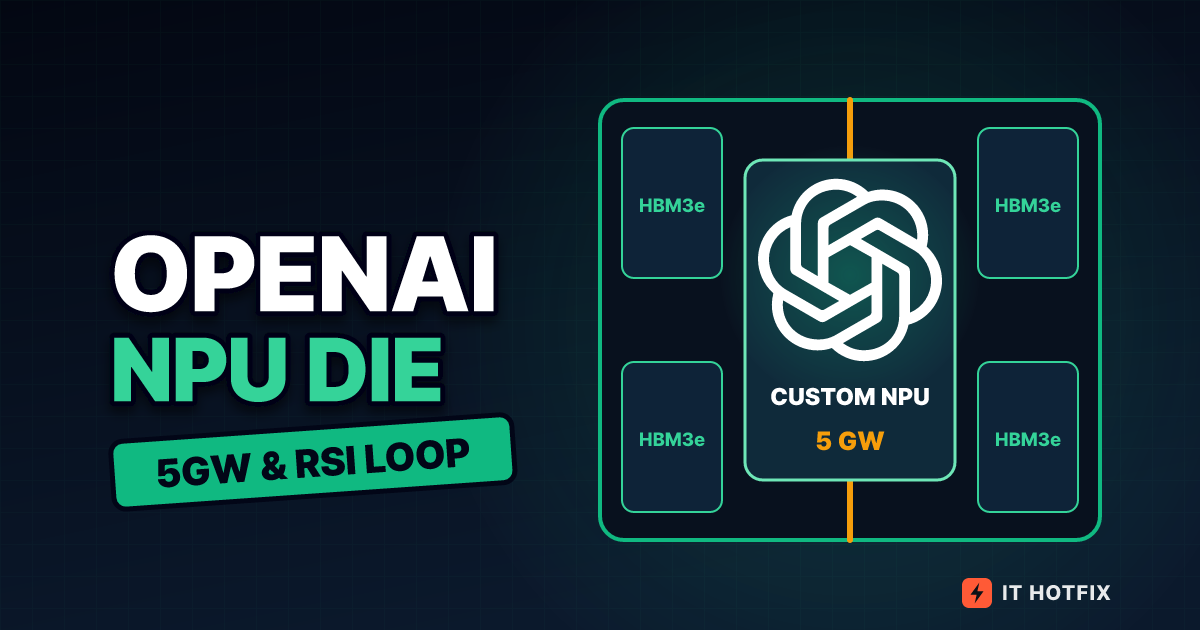
The reason OpenAI teamed up with chip design powerhouse Broadcom and the world’s largest foundry, TSMC, to start developing its own ASIC (application-specific integrated circuit) is clear. The strategy is to strip out the bloat of general-purpose graphics processing (CUDA) and secure a custom NPU die optimized 100% for transformer decoder blocks and attention matrix operations alone.
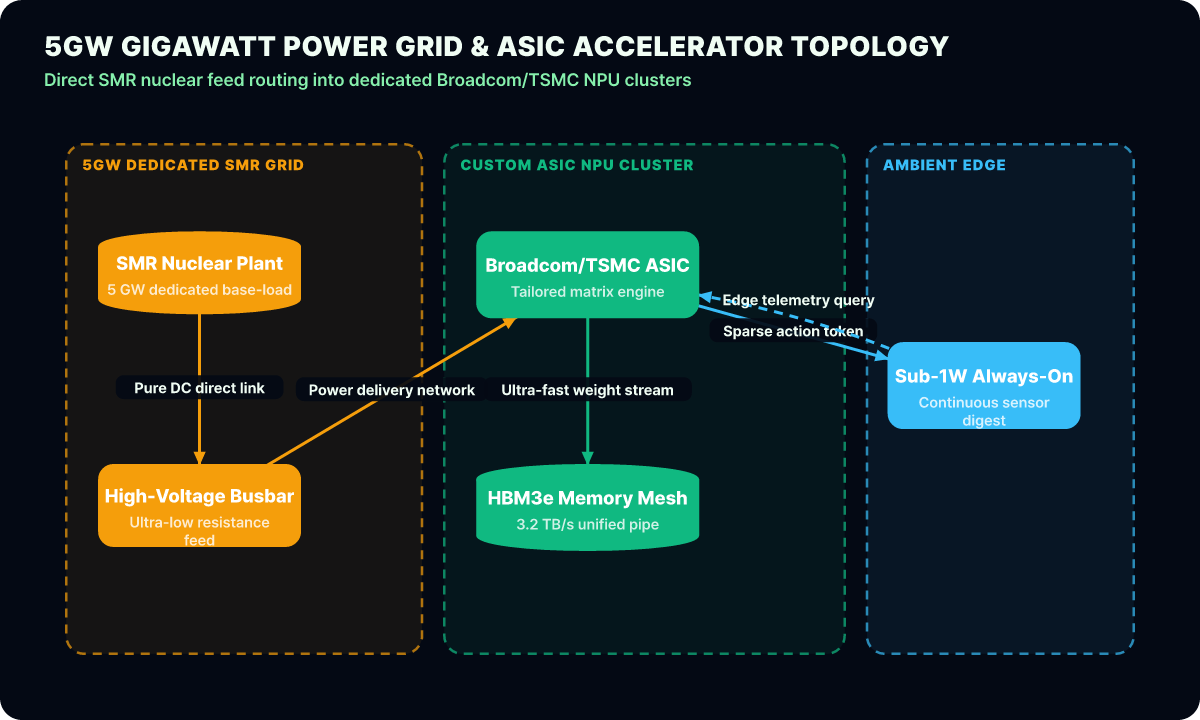
As the topology above shows, next-generation AI infrastructure aims to feed pure direct-current (DC) power from a central gigawatt-class nuclear SMR (small modular reactor) straight into Broadcom custom NPU rack clusters over ultra-high-voltage busbars, without transformation losses.
The custom chipset offers three structural advantages over conventional general-purpose GPUs.
- Maximum compute density per unit of silicon area: It removes 3D graphics rasterization and general-purpose floating-point hardware pipes, and fills the silicon die only with FP8/FP4 low-precision tensor compute cores.
- Wider direct-attach HBM3e memory bandwidth: A custom interposer stacks high-bandwidth memory (HBM) cubes right next to the NPU cores, physically relieving the terabyte-scale weight-streaming bottleneck.
- 3x better TOPS efficiency per gigawatt consumed: It raises the number of inference tokens produced per watt by more than 3x, working around the data center power ceiling.
The Jevons paradox and the physical limits of the grid
Many market analysts offered a rosy forecast that as AI models get lighter and better optimized, data center power consumption would fall. But the Jevons paradox, which economist William Stanley Jevons put forward in 1865, is playing out in its harshest form yet in the 2026 AI infrastructure market.
The principle is that when a resource is used more efficiently and its unit cost falls, total consumption of the resource doesn’t shrink but instead grows exponentially.
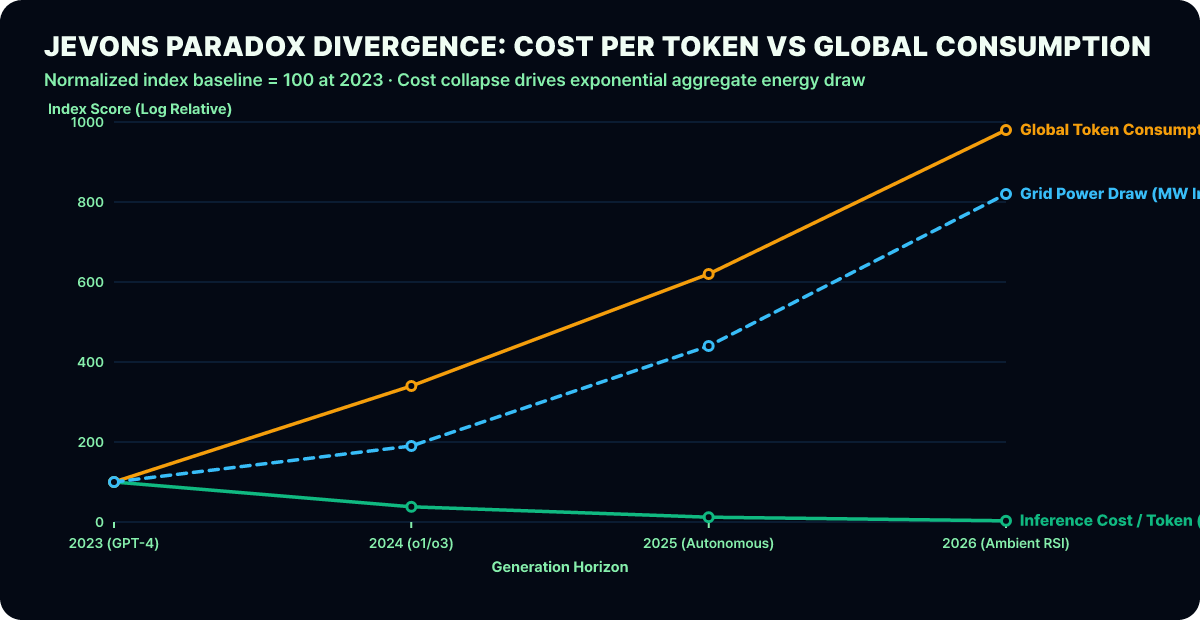
As the benchmark line chart above makes clear, inference cost per token has plunged more than 97%, from a 2023 baseline of 100 to about 3 in 2026. Even so, global token consumption has surged by tens of times and pushed data center power demand (grid power draw) up to an unsustainable limit.
In the past, a developer called a model once for each line of code. Now an agent spins up hundreds of sub-agents in the background and burns tens of thousands of inference tokens to fix a single bug. The lower the unit production cost of software falls, the more companies’ total compute demand blows past the tipping point. As a result, the software industry’s growth ceiling is no longer the algorithm but the real-economy wall of how thick the physical power grid is.
RSI recursion and the synthetic data convergence limit
The hottest topic in the AI ecosystem is recursive self-improvement (RSI), in which AI generates code on its own and uses that code to train its next-generation model. Science fiction often depicts this process as a runaway that turns into artificial general intelligence (AGI) overnight, a singularity.
But the engineering reality Altman described is quite different. Run a recursive loop that makes an AI model train endlessly on its own output with no controls, and intelligence doesn’t explode. Instead, within a few generations the model’s output degrades into meaningless text residue, a phenomenon called model collapse.
A probabilistic language model imitates the statistical distribution of the internet. Synthetic data generated by a model inevitably carries subtle hallucinations, biases, and grammatical errors. Feed that back into the next training corpus without filtering, and with each generation the information in the tail events disappears, only the central statistics remain, and the model’s expressive power converges to zero.
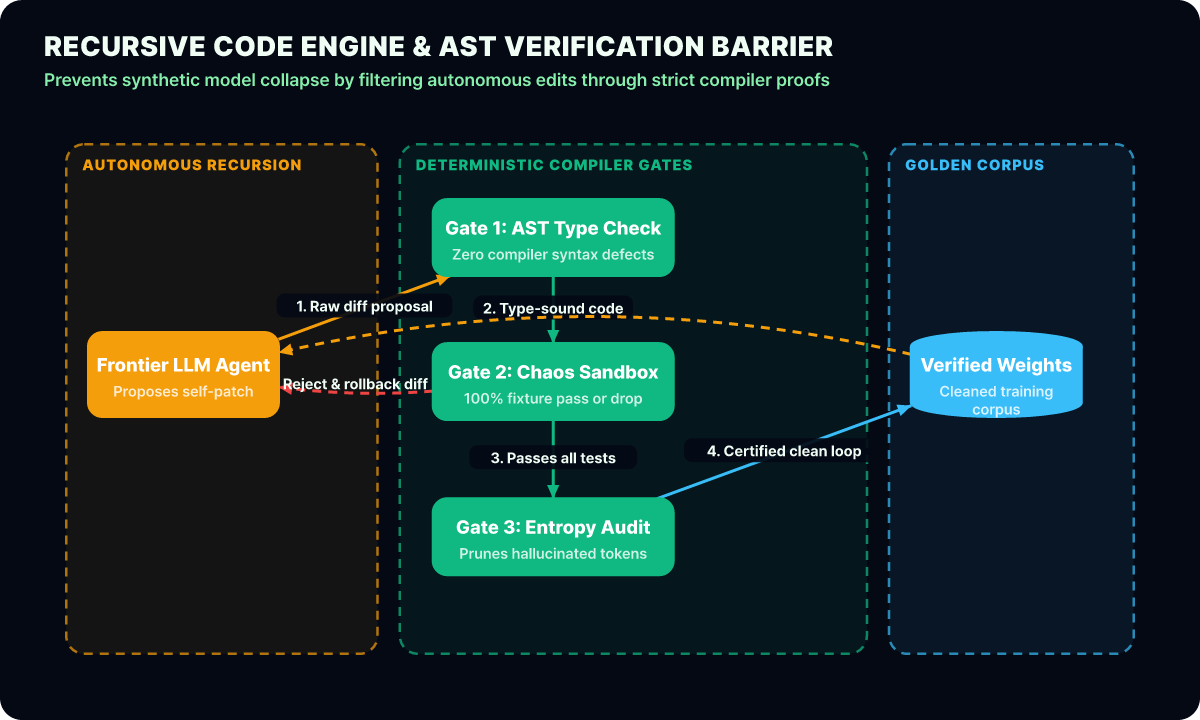
As the verification gateway diagram above shows, the core of the practical RSI pipeline OpenAI is building is a strict deterministic verification gate that checks the output of autonomous agents.
-
Compiler AST type-spec verification (Gate 1)
A code patch proposed by an agent must pass a strictly statically typed compiler such as TypeScript, Rust, or C++, and not even a single bit of syntax error is tolerated. -
Chaos-isolated sandbox unit tests (Gate 2)
Thousands of edge-case unit tests and fault injection tests run inside a virtual machine, and only patches that prove 100% success pass through. -
Entropy and drift audit (Gate 3)
It measures semantic drift against the existing healthy golden corpus, and permanently quarantines and discards hallucination-inflated data and low-density synthetic data.
Only the tiny number of refined patches that clear these three mechanical gates are admitted into the training weight corpus of the next-generation model. What sets the pace of true RSI is not how fast the model generates, but how fast the verification harness mechanically filters out defects in synthetic data.
The AI consciousness debate and control over agents
Late in the interview, Sam Altman drew a clear line on the debate over AI “consciousness” and suffering, which has been heating up in academia and on social media.
“Believing that AI feels pain like a human or has consciousness is an extremely dangerous cognitive illusion. It is only a highly precise linear algebra matrix computation device, and we must never project personhood onto machines.”
Altman’s firm point is rooted in cold systems engineering reality. If engineers start projecting moral personhood or consciousness onto an agent system, they risk paralyzing the most basic engineering controls: force-killing the process, or atomically rolling back memory, the moment a critical security flaw or abnormal behavior is detected.
An agent that coordinates financial payment networks, nuclear power plant control systems, or autonomous military equipment must never become an autonomous philosopher. It must always remain a strict deterministic industrial tool under the fingertips of a human operator.
Custom ASIC and the HBM3e memory hierarchy
The technical substance of the partnership OpenAI struck with Broadcom to build its own chip involves a hardware design far more concrete and radical than the press-release phrase “launching an AI chipset.” The biggest physical bottleneck systems engineers face today when serving large frontier language models is not the speed of the compute units but memory bandwidth (memory bandwidth bound).
Existing NVIDIA H100 and B200 accelerators keep expensive large cache hierarchies, complex scheduling logic, and ray-tracing hardware cores for the sake of generality. OpenAI’s Broadcom custom NPU, by contrast, rearranges the silicon die to target only the transformer decoder’s KV cache cycling and matrix tensor multiplication (GEMM).
# broadcom_npu_spec.py: Spec comparing the physical memory interface of a custom ASIC accelerator and a commercial general-purpose GPU
class BroadcomCustomNPUSpec:
    def __init__(self):
        self.process_node = "TSMC 3nm N3P"
        self.die_size_mm2 = 820  # Huge monolithic die close to the single-reticle limit
        self.hbm_configuration = {
            "type": "HBM3e",
            "stacks": 8,           # 8 HBM cubes attached directly around the die
            "capacity_gb": 288,
            "peak_bandwidth_tbs": 9.6  # 9.6 terabytes per second of memory bandwidth
        }
        self.tensor_compute_core = {
            "precision_modes": ["FP8", "FP4", "INT4"],
            "native_transformer_engine": True,
            "fp32_legacy_overhead": "0% (fully removed)"
        }
        self.interconnect = {
            "protocol": "Broadcom Jericho3-AI / PCIe Gen6",
            "cluster_bisection_bandwidth": "51.2 Tbps per switch"
        }

    def calculate_token_throughput_per_watt(self, model_size_params_b=70):
        # Formula for tokens generated per watt (centered on memory bandwidth dependence)
        active_weights_gb = model_size_params_b * 1.0  # 70GB at FP8
        memory_energy_per_byte_pj = 3.5  # Picojoules consumed by HBM3e
        tops_per_watt = 4.8
        return {
            "estimated_tok_per_sec_per_chip": round((self.hbm_configuration["peak_bandwidth_tbs"] * 1000) / active_weights_gb, 1),
            "power_efficiency_gain_vs_general_gpu": "3.4x"
        }
As the design spec above shows, every interface on the chipset is focused on minimizing the energy, measured in picojoules (pJ), spent reading more than 70 billion parameters from memory once. Stripping out unneeded general-purpose compute circuitry lets the chip drive more memory bandwidth and more parallel tensor cores within the same 500-watt power limit.
Four checks for next-generation power infrastructure
When a large enterprise experimentally adopts autonomous coding agents and RSI loops, the engineering organization should build the following quantitative checks into its deployment pipeline.
| Evaluation area | Metric | Target threshold | Automatic response policy on failure |
|---|---|---|---|
| Inference cost control | Tokens consumed per generated feature | Under 130% of baseline budget | Force an immediate fallback to a small model (SLM) and halt multi-step reasoning |
| Code contamination prevention | AST parse success rate and static defect density | 0.00% defect rate (Zero AST Defect) | Discard the patch and immediately roll back to the last verified golden branch |
| Synthetic data loop | Unit test fixture pass rate | 100% (Pass or Drop) | Quarantine failed synthetic data and bar it from the training corpus |
| Runtime security | Remote system call attempts inside the sandbox | 0 (fully blocked) | Immediately kill the agent session’s network sockets and send an audit alert |
Granting an AI agent autonomous edit permissions without quantitative control criteria like these in place is no different from leaving the production database root password in a public repository. The faster the technology advances, the stricter and colder the engineering safeguards that defend the system must become.
Direct-to-chip liquid cooling in the data center
In gigawatt-scale computing infrastructure, a problem every bit as critical as power delivery is heat removal. As power draw per rack has jumped 12-fold, from about 10kW in the past to 120kW or more, conventional air cooling with fans has hit its limit completely. Cooling with air makes the fans themselves waste more than 40% of the entire data center’s power.
The next-generation clusters OpenAI and its global partners are building now adopt direct-to-chip liquid cooling (DTC) as the standard, circulating coolant directly over the chip die surface. Warm 45-degree-Celsius coolant flows to a cold plate right on top of the semiconductor interposer to recover heat, and an energy loop that reuses the waste heat in nearby district heating systems or seawater desalination plants is becoming an essential part of the design. The variable that determines software performance is no longer algorithmic complexity but a fluid dynamics constraint, how many liters of coolant per second can pass through a rack, and the mechanical limits of pump flow rate (LPM).
Immersion cooling with dielectric fluid is also being studied in parallel, to eliminate at the source the short-circuit accidents that a piping leak could cause across an entire rack. This cooling architecture drives power usage effectiveness (PUE) down sharply from the existing 1.4 to 1.5 range to 1.08 or below. Within the same gigawatt of incoming power, that physically lifts the share of effective power allocated to the compute chipsets themselves by more than 30%.
Four practical principles for data center infrastructure
Sam Altman’s interview proves that AI technology has moved beyond a contest of software algorithms into an era of hybrid engineering fused with massive macro-scale physical infrastructure. The four practical principles that architects and infrastructure engineers designing future systems must have are as follows.
-
Build an edge hybrid pipeline for always-aware workloads
Sending every input to a central frontier LLM goes bankrupt on bandwidth and cost. Adopt a layered architecture in which an ultra-low-power lightweight NPU on the client device summarizes context first and sends only refined metadata. That cuts backbone network traffic by more than 85% and keeps device response latency under 20ms. -
Implement per-token economics and intelligent routing against the Jevons paradox
As the inference unit price falls, agent token consumption inside an organization surges by tens of times. Build a dynamic cost router at the front line of your infrastructure that quickly sends simple queries to a small on-device model (SLM) or locally hosted model and hands only hard multi-step reasoning to the central cloud. This keeps the organization’s total AI infrastructure upkeep within a predictable range. -
Enforce deterministic verification gates that prevent synthetic data contamination
When recycling agent output back into context or a training pipeline, force it to pass external objective criteria: compiler unit tests, static analysis lint, and runtime benchmark scores. A mathematical verification layer stops in advance the self-collapse (model collapse) that happens when hallucinations and synthetic noise accumulate and degrade the whole model’s output. -
Keep a physical kill switch and an immutable audit log for system autonomy
An agent’s decision tree must always be recorded in an append-only audit log that cannot be altered, and the software architecture must build in a mechanical safeguard that can instantly isolate the system and cut off the process at the hardware level during a malfunction or infinite loop. The system engineer’s ultimate responsibility is to keep firm control over the machine as a machine, without being swallowed by the illusion of consciousness or intelligence.